Alba The parish church of Ss. Cosmas and Damian
The titular martyr saints of the sacred building, Cosmas and Damian, are two brother physicians who lived between the third and fourth centuries AD.
Built on the remains of Roman walls and pavements, the church is of very ancient origin; in fact, it is found already mentioned in 12th-century documents.
It was then completely rebuilt in the 1700s from the foundations, and the bell tower was added in the same years.
Interior
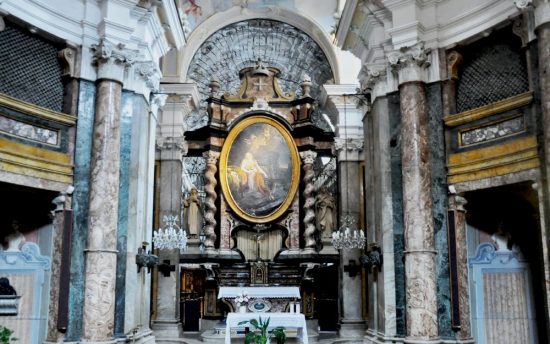
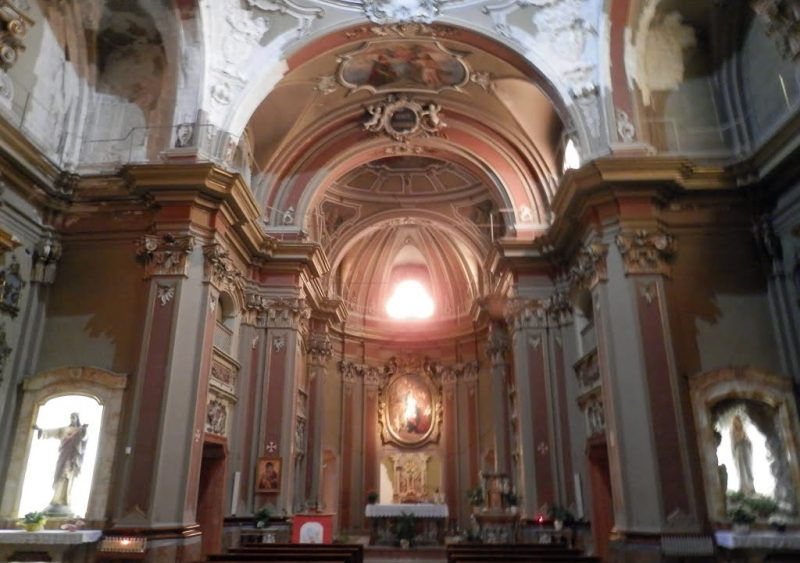
The high altar shows only part of its 18th-century conformation, in polychrome marbles in muted colors, having been dismembered.
Its components are split and still visible in the chancel. One such element and part of the balustrade show the carved coat of arms of the Capriata nobles.
The paintings of the high altar and vaulting
The altarpiece above is a 1761 painting by Claudio Beaumont of Turin. It depicts an archangel showing an image of the Annunciation to theVirgin Mary to the titular Saints Cosmas and Damian, as well as to a sick man attended by them; so that the two venerable men plead for the healing of the seriously ill man.
In the foreground, an angel carries a palm tree branch as a symbol of their martyrdom.
The paintings on the vault of the church date from 1877; in the same year the decorative stuccoes were gilded. In 1921 the Alba painter Fedele Finati restored such pictorial and plastic works.
The works of the side altars
The altars in the two side chapels are no longer the 18th-century ones, nor are their devotional images(Our Lady of Sorrows with Christ Deposed from the Cross, St. Anne).
In fact, in 1892 the eighteenth-century altarpiece on the sacred side mensa of Our Lady of Sorrows was removed and, at the expense of the Company of the same name, replaced with a niche surrounded by a gilded frame in which the processional statue of the Virgin Mary is placed.
A 1961 painting with the same Christological subject by Emilio Prunotto is placed on the central wall.
On the other side altar, dedicated to St. Anne (the mother of the Virgin Mary), the 18th-century altarpiece, attributed to Pietro Paolo Operti of Braid, is visible. It depicts the Eternal Father, the Holy Family and Saints Anne and Joachim.
In 1926 the new organ, made by the Milanese firm Natale Balbiani & figli, was inaugurated.
Exterior
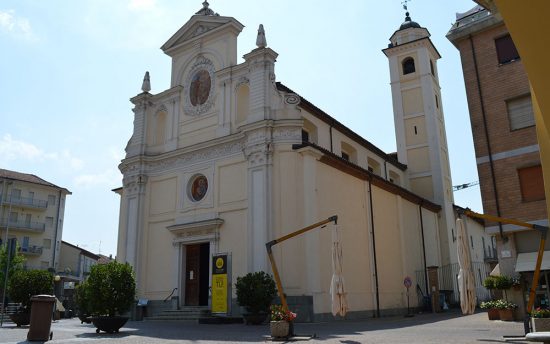
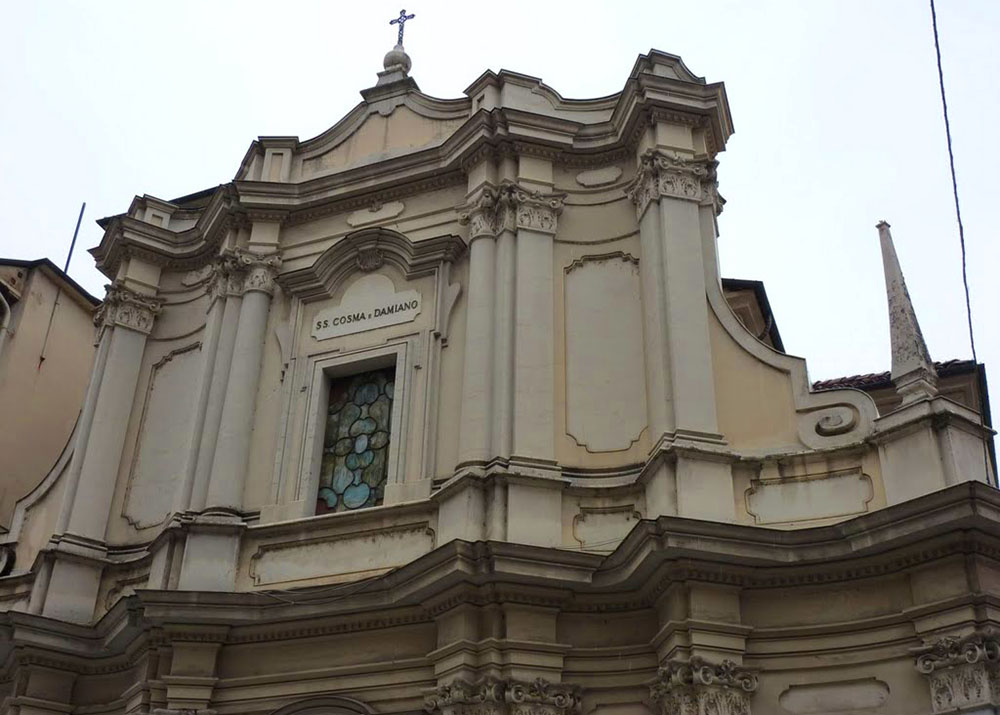
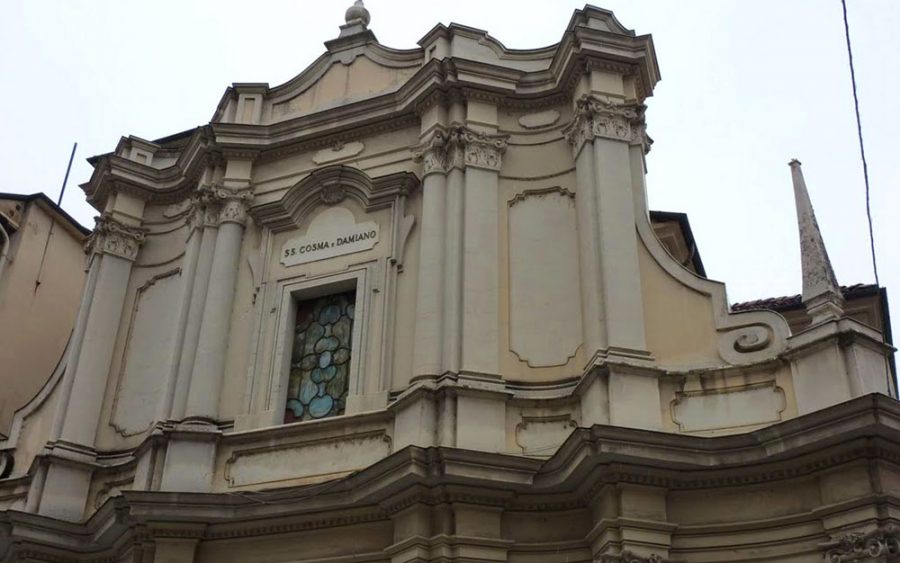
The Baroque church of Ss. Cosmas and Damian is inserted into the curtain road of Vittorio Emanuele Street (the "Via Maestra") almost without apparent volumetric value.
The facade alone is set toward the urban street, contrasting diagonally with the Victorian facade of St. Mary Magdalene, both constituting significant edges of the related crossroads.
The main façade of the church of Ss. Cosmas and Damian is characterized by a Baroque profile that tends toward sinuosity; although the original 18th-century design by architect Rangone appears to have been re-modeled in 1893 to the design of Genoese engineer Adriano Craffonara, partly masking its physiognomy, which was in exposed brick.
The facade is vertically furrowed by two overlapping orders of pilasters of Corinthian type.
A horizontal cornice cuts the surface into two wide sectors. In the one below is the large portal surmounted by a stucco decoration, flanked by two smaller side ones.
In the upper sector, in the center between Ionic-type coupled pilasters, is the rectangular window, framed in stucco and underlying anepigraph dedicated to the two titular saints.
The plant and the vaults
The body of the church has a longitudinal plan (reversed from the opposite orientation of the pre-existing cultic site) with a single nave, interspersed symmetrically with two side chapels.
The vault system is quite complex: barrel vaults alternate with elliptical dome elements. The entire ensemble is decorated with refined stucco.
The bell tower
The bell tower, erected later, shows already neoclassical forms: projecting cornice toward the top, pilasters, oculi and narrow openings in the walls.